
The Mountains Learn Your Name
Dragonbreath part 8

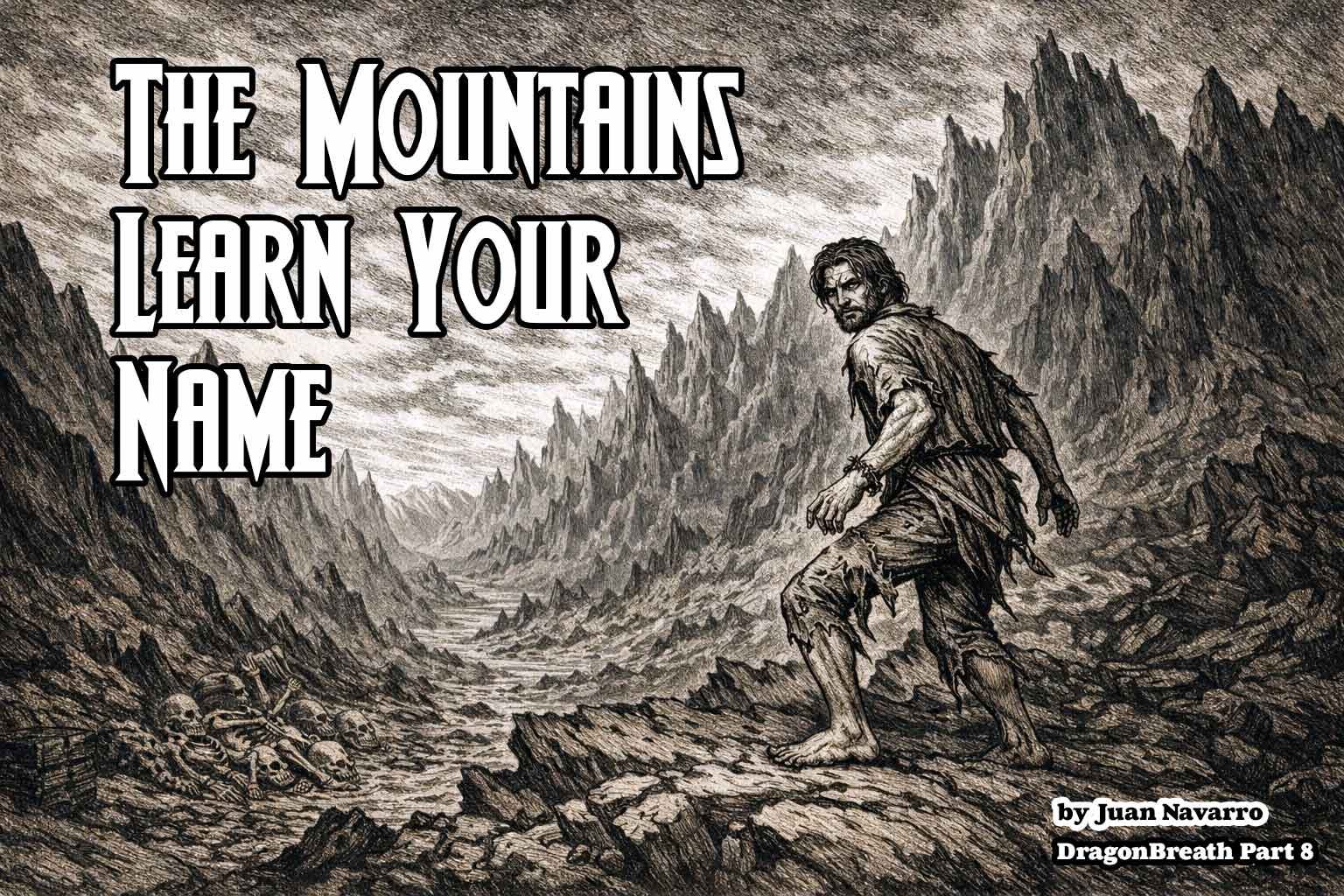
No one remembered when the Pox Mountains finished forming. Some claimed the land had blistered up overnight, after a storm of red lightning that boiled the rivers and cracked the ground. Others whispered older stories: that the first chains ever forged were hammered into living earth, and the mountains rose in protest, marking the place with scars the world could not heal. No one agreed if it was gods or men or something older, but everyone agreed—nothing about the Pox Mountains was natural.
They remembered the screaming.
The first thing Jerrik learned after slipping his chains was that running made noise, and the Pox Mountains hated noise. Feet slapped stone. Chains clinked. Breath burned. Each desperate sound sent tremors skittering through the ground, echoing further than any shout. Even his heartbeat seemed to thud too loudly, pulsing in his ears. Every sound—slavers laughing, his own panicked breaths—made ripples Jerrik could feel under his skin. Not just the fear of being heard. The world itself seemed to shift with every careless noise, stone flexing, and paths twisting. Once, a distant shout behind him made a ledge crack loose and tumble, blocking one way and leaving only the sharper, narrower path forward. The mountains remembered sound, and they punished it.
The second thing he learned was that stopping meant dying.
He ran barefoot into a landscape that looked like it had been smashed into place by an angry god. Nothing moved. Peaks rose in frozen violence, jagged like shattered glass, stacked and twisted as if an explosion had been frozen in time. The silence scraped at him. There were no slopes, no mercy. Just rock claws stabbing at the sky and valleys so narrow the sun barely reached inside.
Behind him, the slavers shouted.
Ahead of him, the mountains waited.
Jerrik had heard the stories. Everyone had. The Pox Mountains didn’t kill you fast. They didn’t need to. They made sure you finished yourself. But even with every campfire warning and whispered tale, what Jerrik remembered most was Tara’s face—how she had laughed at fear, how her eyes had glinted with fierce defiance that last night before she crossed into these same twisted cliffs three winters before. He could still recall the words she teased him with after the lightning storm, about catching shadows that moved against the rock, her promise that she would leave some sign if she found a way through. But in the end, it was only her red scarf left snagged on a splintered stone, and the echo of her footsteps dissolving into silence. He had never found out what happened, never had the chance to say what he should have. Now, with every step deeper into the range, it wasn’t the mountains he dreaded facing. It was the answer waiting somewhere inside.
He ran anyway.
The slavers’ camp still burned in the distance, orange light flickering against bruised clouds. They had been careless, drinking too much and laughing at the prisoners. Jerrik still felt the iron weight of the collar that had been around his neck just hours before, its absence louder than any wound.
He ran until his lungs tore themselves like starving animals.
The wind found him.
It screamed through the passes, never steady or honest. Gusts came sideways or from below, then fell into dead-still silence that pressed against his ears until he thought his skull would crack. The wind carried things: smells that tangled with memory and dread, the copper sting of old blood, rot that reminded him of the fever-sick air from childhood nights spent sweating and terrified, smoke baked into stone, and magic so old it had spoiled. Sometimes the color of the air shimmered with metallic hues or lost words pulsed in the wind, snaring his thoughts or making his skin prickle with distant pain. Rock would hum as he passed, or shadows would slide almost imperceptibly across the stone. Every scent wormed its way beneath his skin, making the mountain feel full of his own panic, exhaled and waiting.
The Pox Mountains smelled like history refusing to die.
He ducked into a crevice no wider than a coffin, stone shredding his shoulders as he squeezed through. The rock felt wrong, too sharp and too eager. It bit him. Not metaphorically. He left skin behind. The mountain kept it.
As he stumbled deeper, wiping blood from his raw arms, the stone beneath his feet seemed to shift, subtly revealing a narrow path that hadn’t been visible before. His blood darkened the rock and, where it stained, the way forward opened just enough for him to slip through.
That should have scared him more.
Jerrik collapsed against a wall of stone that leaned inward like a jaw. He laughed once, short and hysterical.
“Good choice,” he wheezed. “Brilliant escape.”
The laughter echoed back distorted, stretched thin, like the mountains were mocking him in his own voice.
He slept for maybe an hour.
The dreams were worse. He dreamed the mountains were moving.
But this time, in the shifting nightscape, he glimpsed a way out—a narrow arch streaked with red, an old rune carved there, the word “Endure” scratched beneath. In the dream, his own bloody hand pressed against the rune and the stone gave way, revealing a sliver of light. Not walking. Growing. The mountains shifted by increments so small they should have been impossible. He saw a single ridge tilt a finger-width, a boulder nudge minutely closer. A crevice that had always seemed just wide enough suddenly pressed inward with the hush of settling dust. The world altered in ways that should not have gone unnoticed, and yet there was no mistaking it. He dreamed of stone remembering pain, of blood soaking into cracks and being drunk like wine.
When he woke, something had changed.
The path behind him was gone. Not collapsed. Not blocked. Just a sheer blank wall where the way had been.Gone.
Where there had been a passage, there was now a sheer wall of rock, jagged and seamless, like it had never been anything else. Jerrik pressed his hands to it, and the stone bit deep; he felt skin split and blood bead across his fingers, pain flaring hot and instant. For a breath, he saw his own hands as he had seen others’: shackled, scarred, marked by hurt given and received. The sting reminded him of wounds long ago, some his own doing, some he had never apologized for. He left his blood on the wall, unable to tell if he was paying some old debt or begging silent forgiveness.
“No,” he whispered.
The mountain did not answer.
He moved deeper.
Time broke down here. The sun came and went at random, sometimes hanging in the sky overlong, sometimes vanishing in what felt like minutes. Jerrik lost track of days, so he counted the frantic beats of his heart, using their wild rhythm to measure the passing hours. Hunger became the new clock; each growl in his stomach was another tally against reason. His water skin shrank by gulps—at last, only half a swallow left, which he rationed by desperation, lips sticky with thirst. Thirst itself became a voice whispering from inside his skull. His feet split open. He wrapped them in rags torn from his shirt and kept moving.
He began to find things.
Bones, mostly.
Some were old, picked clean, and bleached white. Some were recent, still wearing scraps of armor, shackles, and rings. He once found a slaver’s sigil, snapped in half. He laughed again when he saw it.
“Good,” he told the bones. “Rot together.”
At a narrow ridge, he found a man still alive.
Barely.
The man was wedged between two leaning slabs of stone, ribs crushed inward, legs gone entirely. His eyes tracked Jerrik weakly. His breath rattled and, for a moment, it seemed he might already be more shadow than flesh. He squinted at Jerrik with something like recognition, or maybe accusation. When Jerrik knelt, the man’s cracked lips moved. “Were you ever the one holding the chain? Or just the one who watched?” he whispered, voice barely more than wind. His gaze pinned Jerrik, forcing every memory of silence and inaction to surface, every moment he had not fought, not spoken, not run. “Did you run sooner than the rest, or just faster?”
“Don’t,” the man croaked. “Don’t go that way.”
Jerrik swallowed. “I don’t have a map.”
The man smiled, lips cracked and bloody. “None of us do.”
“What happened to you?”
The man’s eyes flicked upward, toward the peaks. “They learned us.”
Then he died.
That night, the mountains spoke.
Not in words.In pressure. It pressed against Jerrik’s skin, softly at first, then with a subtle insistence. The weight was not constant. It throbbed, almost like a slow, giant heartbeat pulsing through the stone. He felt it under his ribs, a rhythm just barely out of sync with his own, a living tension in the rock. Each pulse seemed to echo through the crevices and hollows, a silent language the mountains spoke to themselves. The pattern repeated, steady and deliberate, hinting at a presence deeper than stone, something ancient and attentive. Jerrik shivered, trying to measure the rhythm with his own breath, knowing the mountain would keep speaking whether he heard it or not.
Jerrik woke, unable to breathe, stone walls inches closer than before. He shoved, screamed, scraped himself raw, and forced his way out. When he finally stumbled free, gasping, he saw the truth under the moonlight:
The peaks had shifted.
Not much. Enough.
The Pox Mountains were closing.
He ran again, half-mad, screaming curses, jokes, prayers, anything to keep his voice sounding human.
“Listen,” he shouted to no one, “I don’t taste good! I’m all gristle and bad decisions!”
The wind laughed. The ground at his right shifted with a grinding sigh, a sliver of stone scraping sideways and sealing off a gap he might have chosen. The mountain answered his humor with silence and a threat, and for a moment the weight of the peaks pressed closer, tightening around his lungs.
At dawn, or what passed for it, he reached a valley so narrow he had to turn sideways to get through. Halfway across, something moved.
Not stone.
A thing rose from the ground like a mistake. It was humanoid, but wrong, its body crusted in rock and dried blood, eyes hollow and shining faintly. Jerrik realized as it lurched toward him that the mountains did not simply destroy the guilty—they kept them, molding their remains into something that could never leave. Slavers, murderers, those who had spilled blood without remorse were recycled into husks, their purpose now to haunt the stone that had judged them. The Pox did not forget. It shaped its guardians from those it deemed irredeemable, using their guilt to bind flesh to stone, memory to silence.
A slaver.
What had once been one.
It lunged, silent.
Jerrik screamed and stabbed with a broken shard of metal he’d carried since escaping. The shard sank into stone-flesh. The thing didn’t bleed. It didn’t react. It just grabbed him.
Jerrik bit it.
A bit hard.
The taste was iron and dust and old regret.
The thing paused.
Then it crumbled.
Not died. Unmade. Falling apart into gravel and bone.
Jerrik stared, shaking.
The mountain had let him have that one.
By the fourth day, or what he thought was the fourth, he understood.
They were shaping.
Jerrik touched the ridged scars along his back, feeling their jagged edges beneath his shirt—old wounds hardened and fused like hammered steel. He realized now: the mountains did not just grind strangers down or swallow the guilty without sense. They took slavers, killers, cowards, and taught them how to die slowly. They took the desperate and tested whether desperation might be reforged. Jerrik’s own scars remembered, turned iron by ordeal, the same way the stone remembered every cry and every drop of blood. The Pox Mountains did not forget or let go. They remade.
They took slavers, killers, cowards, and taught them how to die slowly. They took the desperate and tested whether desperation could become something else.
Jerrik stopped running.
He walked.
He chose his steps carefully. He didn’t shout. He didn’t laugh. He didn’t pray.
He respected the stone.
When he bled, he let it fall.
When he found bones, he stepped around them.
At the highest pass, where the sky cracked open into sickly violet light, the mountains opened a way.
Just barely.A path barely wider than hope.
On the far side, grass, not the memory of grass, but living, green blades trembling in the dawn air. He dropped to his knees. The frost-wet blades pressed cool and forgiving against his palms, leaving damp streaks on his battered skin. He inhaled the scent—unexpectedly sweet, fresh as rain after every wound and nightmare. The softness pushed against his fingers and face, utterly unlike the unyielding stone, each touch a small promise he was not trapped anymore.
Real grass. Jerrik collapsed into it, sobbing, laughing, broken. For the first time in days, he felt the world give way rather than take more.
Behind him, the path sealed shut.
The Pox Mountains stood silent, jagged, patient.
They had taken their tithe.
And somewhere deep in their stone guts, they remembered his name. Jerrik felt the weight of this memory settle over him. He had survived, but survival alone was not enough. He understood now what the mountains had tried to teach him: you could not outrun what you carried inside. He was not the same man who ran, desperate and wild, into the stone. The scars and silence had shaped him, pressing new knowledge into his bones—about endurance, about guilt, about letting go. What remained was not just a boy who had escaped, but someone who had finally learned how to walk forward, and why.
Which was more than most ever did.